Data Analysis for Asset Management Decision-making
About this course
Making decisions based on data is crucial in the asset management environment of today. This course gives you the tools to efficiently gather, process, and analyse data so that it may be used to inform strategic choices.
You will build a strong understanding of data principles, data quality, and analysis methods through self-paced learning, with a focus on using Microsoft Excel. A live session will help you see how these concepts apply in the real world by working through practical case studies. Finally, you’ll put your learning into action by visualising data and creating a compelling presentation to support informed decision-making.
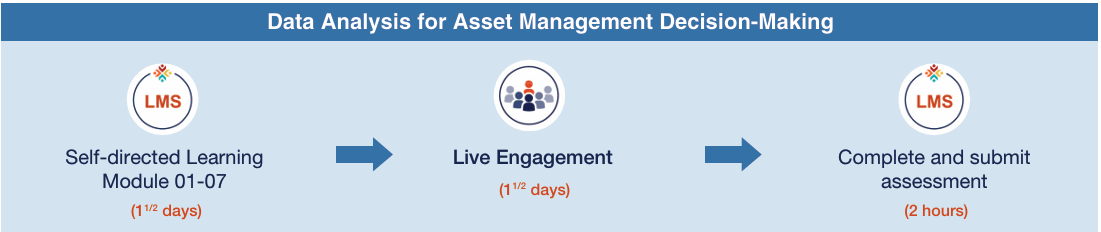
You’ll begin with seven self-directed learning (SDL) modules, designed to build a solid understanding of the theoretical principles of data analysis in the context of Asset Management. Module 04 is longer than the others, as it focuses on using Microsoft Excel for data analysis. It includes hands-on practice with key functions in the software.
The SDL concludes with a quiz, which must be completed before the live engagement session. During the live session, you’ll apply the concepts covered in the SDL using case studies. The final course assessment brings everything together, requiring you to visualise data and create a compelling presentation to support informed decision-making.
Outcomes

Explain the role of data analysis in effective asset management decision-making
Differentiate between data, information, and knowledge in an asset management context
Describe the data management process
Identify relevant data sources for asset management decision-making
Explain key considerations for effective data collection
Use Excel to organise and analyse asset data
Assess and improve data quality to enhance decision-making
Select and apply appropriate analysis techniques to solve asset-related issues
Interpret and present data-driven insights visually for stakeholder engagement
An Introduction to Data
Explore the role of data in asset management, and learn how to distinguish between data, information, and knowledge. Understand the full data management process and its impact on decision-making.
Data Requirements
Learn how to identify the right data sources to support effective asset management decisions.
Data Collection
Discover key principles for collecting accurate, relevant data that can be trusted for analysis.
Data Processing
Get hands-on with Excel to clean, organise, and analyse asset data for practical use.
Data Quality
Understand how to assess data quality and apply strategies to improve it for better decisions.
Data Analysis and Modelling
Learn how to choose and apply analysis methods to solve common asset management challenges.
Data Visualisation and Communication
Develop skills to turn analysis into clear, compelling visuals that support stakeholder understanding and buy-in.
Learning journey
Who should attend?
- Maintenance planners
- Maintenance supervisors
- Asset care engineers
- Reliability engineers
Format and duration
- Blended learning, with elearning and virtual classroom contact sessions.
- 24 notional hours
- Formative activities
Terms and conditions of registration and use
All registrations received are regarded as confirmed and subject to the following:
- Payment must be made before the course start date or within 30 days of invoice date, whichever occurs first. Once payment has been made, please send proof thereof via email to: [email protected].
- Refunds and/or substitutions are not applicable if a learner has: enrolled for a course and accessed it via the Pragma Academy Learning Management System; or attended a classroom session; or has enrolled, but failed to attend without notifying the Pragma Academy at least seven (7) working days prior to course start date.
- Refunds and/or substitutions are applicable: if cancellation is received in writing at least fifteen (15) working days before the scheduled start date of the course, a full refund is applicable; if cancellation is received in writing at least seven (7) working days before the scheduled start date of the course, a 50% refund is applicable; if a learner who enrolled in a course due to take place in less than fifteen (15) working days, sends a substitution learner subject to the substitution learner meeting the minimum prerequisite qualification requirements.
- It is the learner's responsibility to ensure that they meet the prerequisite requirements for a course they are enrolling in. Proof of suitable prerequisite qualifications will be required.
- Pragma reserves the right to cancel any advertised course due to insufficient enrolments or conditions beyond our control.