Measuring and Managing Performance
About this course
This course lays the foundation for developing an asset management (AM) scorecard.
Over the course of seven topics, it explains performance measurement terms and concepts, such as objectives, key performance indicators (KPIs), leading and lagging indicators, PDCA cycle (plan, do, check, act), and data versus information.
It then provides a framework for a “balanced AM scorecard” and discusses the use of benchmarking for setting targets.
Finally, it emphasises the identification of forums where KPIs can be discussed and action taken in line with the PDCA cycle, providing a template for a measurement plan.
Outcomes

Explain the reasons for measuring business performance and acting on the results
Explain the different terms and concepts related to performance measurement
Identify measures for performance, work management, reliability, process, cost, risk and people
Select measures for an organisation, department or team, and structure them into a balanced scorecard
Explain how to deploy tactical KPIs and targets to an operational level, ie the relevant organisational department and teams
Select appropriate measures tailored to individuals, contractors, assets, projects and other relevant areas to effectively manage the
organisational function
Implement measures by identifying data sources, processing and visualising the data, and creating reports tailored to the target audience
Use benchmarking effectively to set SMART improvement targets
Identify the right forums and mechanisms to review KPIs and drive improvements
Have a sense of how to react to certain measures, enforced through practical case studies
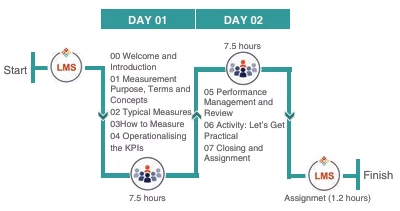
Measurement Purpose, Terms and Concepts
This module explores the importance of measuring business performance and using the results to drive improvements. It introduces a variety of key terms and concepts related to performance measurement, providing a foundation for analysing and enhancing organisational effectiveness, and a clear understanding of how businesses assess success and make informed decisions.
Typical Measures
This module examines key performance measures across different business areas, including production and asset performance, work management, reliability, processes, cost, risk and people. It provides insight into how organisations can apply these metrics to various aspects of business operations to assess and improve overall business performance.
How to Measure
This module focuses on the practical application of performance measurement through the construction of a balanced scorecard. Learners explore how to effectively measure the performance of organisations, departments, teams, individuals, contractors, assets, projects and functions (audits) to drive continuous improvement and strategic decision-making.
Operationalising the KPIs
This module provides a practical approach to developing actionable key performance indicators (KPIs) from various data sources. Learners explore techniques for processing and visualising data effectively, creating insightful reports, and ensuring data accuracy to drive effective performance measurement and decision-making.
Performance Management and Review
This module discusses how to effectively manage and evaluate performance using KPIs and other measurement tools. Participants learn best practices to ensure that measures and KPIs are reviewed by the appropriate individuals and teams. The module unpacks how to use benchmarking effectively to set SMART (specific, measurable, achievable, relevant, time-based) improvement targets and limits. It further explores how to react to certain measures by making informed decisions based on data insights.
Activity - Let's Get Practical
In this module, learners engage in practical activities to apply some of the skills they have learnt in this course. In the two group activities, learners discuss problem-solving topics in their group, then share their answers with the other groups, with guidance from the facilitator.
Closing and Assignment
In this final module, participants round off what they have learnt in the course with an assignment that will evaluate their understanding of the subject matter.
Learning journey
Who should attend?
- Management
- Production managers / supervisors
- Engineering managers / supervisors
- Engineers
- Project managers
- Maintenance supervisors / foremen
- Maintenance planners and schedulers
Format and duration
- 16 Notional hours
- Virtual instructor-led training or classroom training
- Note: Learners will need individual laptops for this training course.
Take-home tools
- KPI template
- KPI measurement plan
Terms and conditions of registration and use
All registrations received are regarded as confirmed and subject to the following:
- Payment must be made before the course start date or within 30 days of invoice date, whichever occurs first. Once payment has been made, please send proof thereof via email to: [email protected].
- Refunds and/or substitutions are not applicable if a learner has: enrolled for a course and accessed it via the Pragma Academy Learning Management System; or attended a classroom session; or has enrolled, but failed to attend without notifying the Pragma Academy at least seven (7) working days prior to course start date.
- Refunds and/or substitutions are applicable: if cancellation is received in writing at least fifteen (15) working days before the scheduled start date of the course, a full refund is applicable; if cancellation is received in writing at least seven (7) working days before the scheduled start date of the course, a 50% refund is applicable; if a learner who enrolled in a course due to take place in less than fifteen (15) working days, sends a substitution learner subject to the substitution learner meeting the minimum prerequisite qualification requirements.
- It is the learner's responsibility to ensure that they meet the prerequisite requirements for a course they are enrolling in. Proof of suitable prerequisite qualifications will be required.
- Pragma reserves the right to cancel any advertised course due to insufficient enrolments or conditions beyond our control.