Root Cause Analysis for Supervisors
About this course
Train your Maintenance Supervisors and their peers to do effective root cause analysis in support of your focused improvement drive.
This practical course covers Level 2 problem solving, where a small multi-disciplinary team must solve a medium-sized technical problem within one to two weeks.
The focus of the course is on root cause analysis using a causal tree for a real-life scenario.

Outcomes

Explain the importance of effective problem solving to achieve the company’s objectives
Explain the principles, rules and traps for root cause analysis
Describe the three levels of problem solving and the role of the supervisors in it
Apply these rules to develop a logical causal tree for a given problem
Explain the steps in the IDMAIC problem solving process
Use evidence to identify and confirm the root cause(s) of the problem
Clearly define a given problem based on the available information
Identify and prioritise possible solutions to prevent a recurrence of the problem
Describe the importance of accurate data for effective problem solving and how it can be obtained
The need for structured problem solving
Explain the importance of effective problem solving to achieve the company’s objectives.
A framework for effective problem solving
Describe the three levels of problem solving and the role of the supervisors in it.
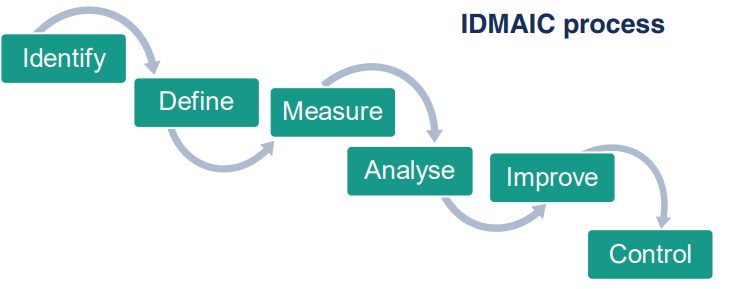
Overview of the IDMAIC process
Explain the steps in the IDMAIC problem solving process
Define: Understand the problem
Clearly define a given problem based on the available information.
Measure: Collecting accurate information
Describe the importance of accurate data for effective problem solving and how it can be obtained.
Analyse: Causal trees and verification using evidence
Explain the principles, rules and traps for root cause analysis.
Apply these rules to develop a logical causal tree for a given problem.
Improve: Identifying possible solutions
Use evidence to identify and confirm the root cause(s) of the problem.
Identify and prioritise possible solutions to prevent a recurrence of the problem.
L2 Problem Solving in Practice
Explain how Level 2 problem solving works in practice in terms of duration, responsibilities and deliverables.
Who should attend?
- Maintenance Supervisors
- Production Supervisors
- Maintenance Planners
- Senior Technicians
- Engineers-in-training
Format and duration
- This course can either be delivered as VILT (Virtual Instructor Led Training) or face to face ILT (Instructor Led Training)
- 16 notional hours
Take-home tools
- Participants will get a copy of a Level 2 Problem Solving template which they can take home and customise for future use.
Please Note: Individual laptops are a requirement for this training for the following reasons:
The root cause analysis will be done using an online brainstorming tool (Mural)
The practical exercise requires the completion of a MS Word template
A final knowledge quiz must be completed on the Pragma LMS
Terms and conditions of registration and use
All registrations received are regarded as confirmed and subject to the following:
- Payment must be made before the course start date or within 30 days of invoice date, whichever occurs first. Once payment has been made, please send proof thereof via email to: [email protected].
- Refunds and/or substitutions are not applicable if a learner has: enrolled for a course and accessed it via the Pragma Academy Learning Management System; or attended a classroom session; or has enrolled, but failed to attend without notifying the Pragma Academy at least seven (7) working days prior to course start date.
- Refunds and/or substitutions are applicable: if cancellation is received in writing at least fifteen (15) working days before the scheduled start date of the course, a full refund is applicable; if cancellation is received in writing at least seven (7) working days before the scheduled start date of the course, a 50% refund is applicable; if a learner who enrolled in a course due to take place in less than fifteen (15) working days, sends a substitution learner subject to the substitution learner meeting the minimum prerequisite qualification requirements.
- It is the learner's responsibility to ensure that they meet the prerequisite requirements for a course they are enrolling in. Proof of suitable prerequisite qualifications will be required.
- Pragma reserves the right to cancel any advertised course due to insufficient enrolments or conditions beyond our control.